Études and exercises
Clarinet issues for interpretations:
Concert version
Each musician performs their own micro ballet. The fingers move to cover the holes and press the keys, breathing in we open the mouth in a greedy gesture. This all together is a subliminal choreography that builds sound and tension.
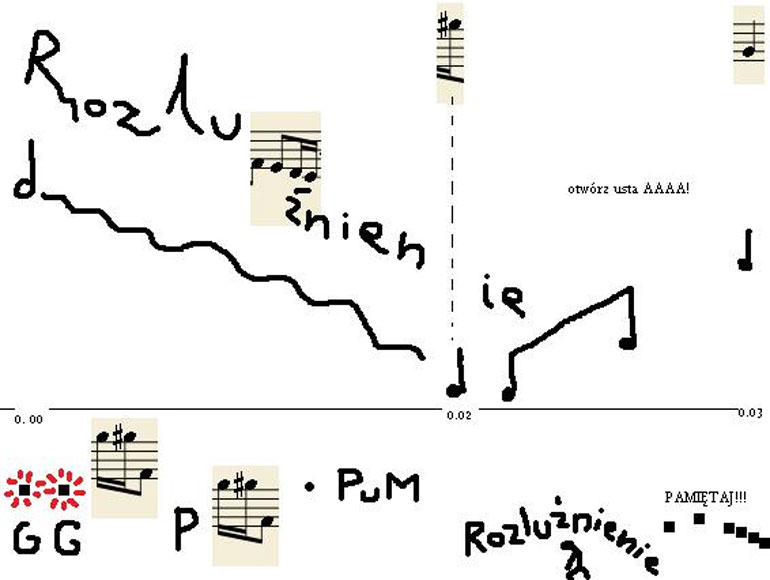
0. 00 0. 01 Relaxation I I – open your mouth [ one accent F ] - g g – P – P Pum – Relax I I I I
Now I'd like to make a note about instrumentalists movement. The basis is entering the stage, which you can't run from :) but it's this entrance , the way of entering, that decides what type of a musician one really is. Here are examples of those ways depending on the musician.
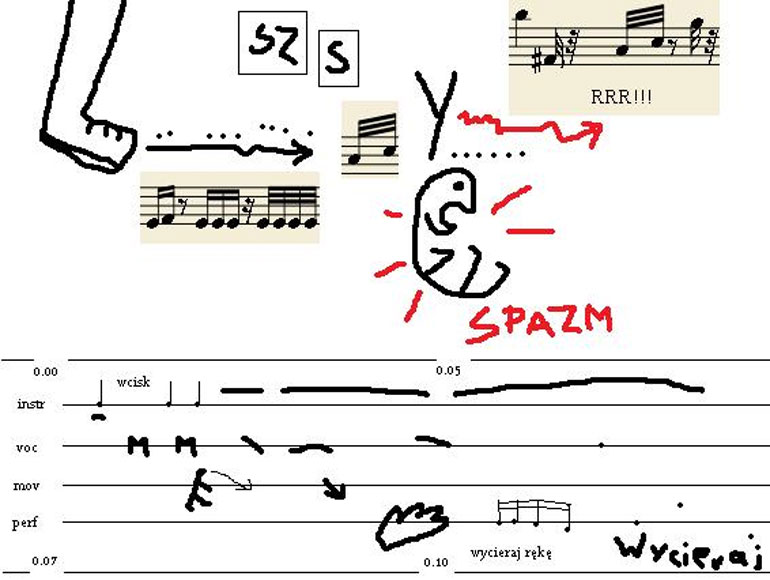
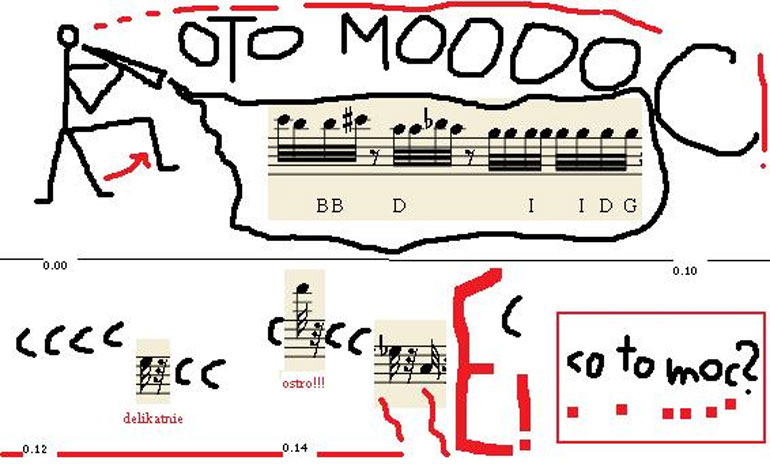
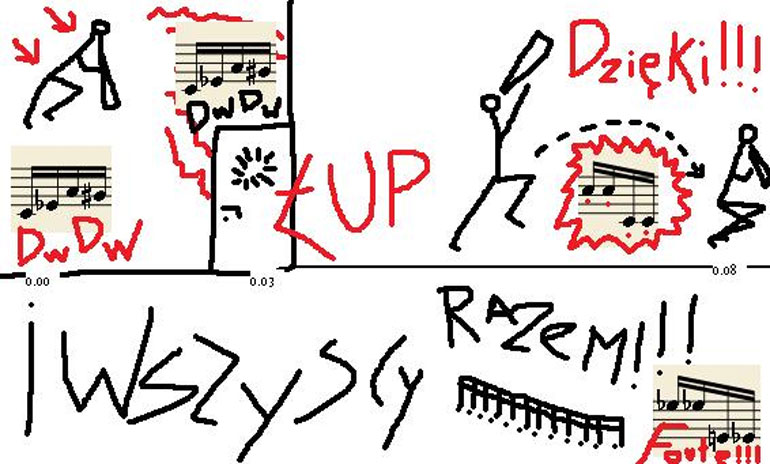
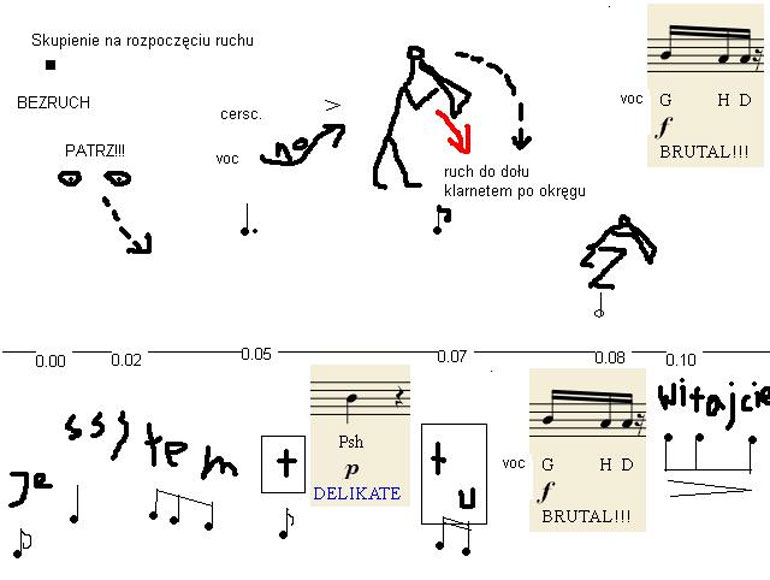

These five musical types can be written down like a piece and combined with fragments of remixed contemporary pieces or one's original sound propositions on the basis of juxtaposition and interpretation. I don't believe that even the most withdrawn musician, hearing the word 'improvisation', doesn't do this: inhale, and lets his consciousness loose freestyling with various sounds. I would be very glad if he stopped right there and thought about what he just played. Man, you just let the power of your fingers go, you let the air flow like the best wind instrument improvisers in the world do. Of course it made sense in these 3 seconds during which you did your finger fidgeting. You could not enter the stage and play this kind of fidgeting for an hour because you would be considered a happy-go-lucky optimist. This fidgeting makes perfect sense. A potential that just needs to be directed to the process of concert energy. Above all, let's name this fidgeting. A quick movement downwards with your fingers, crescendo and a couple of notes in staccato inserted here and there, a whole bunch of movements: inhaling (we can start shaping this act with a word like, for example, sudden inhale, calm inhale), finger movements (here again, shaping with words: fingers very high, crazy fingers, stiff fingers), sets of little movements that point to the fact that the clarinet player is great, decisive and ready for playing (correcting the body pose on the chair – 'screwing in', leaning backwards while inhaling like a 'chief before a battle'. This is how this worm up incident can be written down and how it can be transformed through the main subject of the notebook of my études.
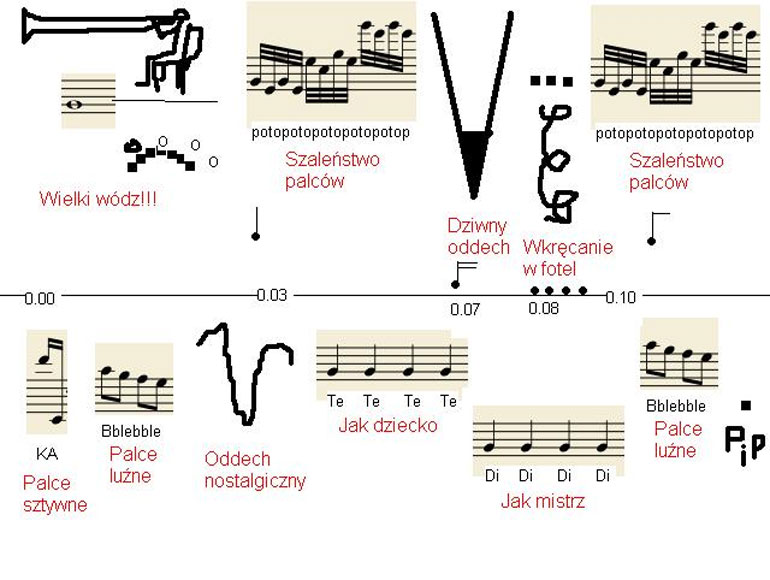
A piece arranged in such a way is a structure suspended in space, which can be asked any time to do something in space and for the space. We play in space and we are in space and in music this 3D reference it's still missing. Therefore let's try to broaden the formula of the 'étude being played' adding the spacious aspect and what can be done in space. We fold out the score cut into fragments in order to play the fragments that are arranged in space, for example this way: on the note stand, on a chair, on the floor, under a chair so the chair is an obstacle, in flight – suddenly 'soaring' notation (here very important is the relation with the instrumental technique). What is the genuine relation between the instrument, playing it and the movement which is a momentary 'letting go' of the focus on music.
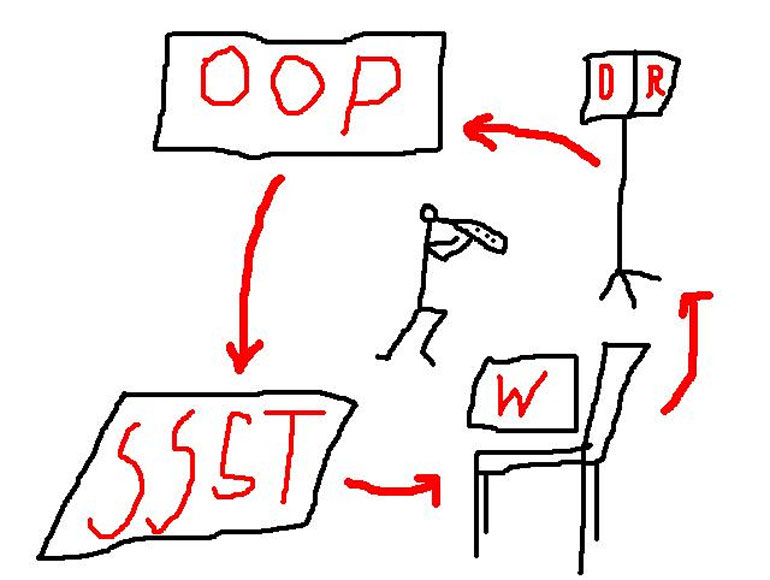
After action in space I'd like to present a relation that is important to me, a relation between a music notation that can musicalize each gesture, each reaction on the level of 'finger movement to play – pull the shirt to perform the noted accent'.
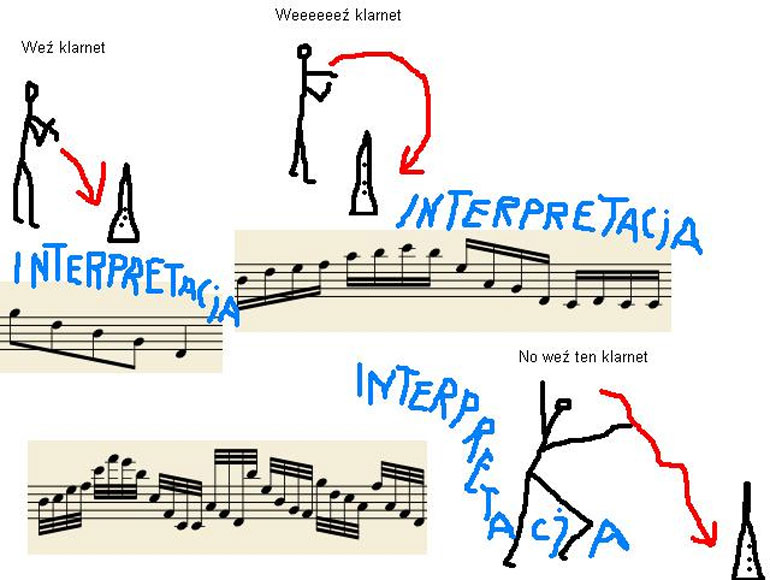
The presented relation between the musical piece and space at that point is to be directed in a special way to the issue of movement in space, cutting through air with gestures and sound which is a 'wild intervention'. Not standing in place focused on virtuosic performance but penetrating, permeating through units of millimeters, centimeters or meters into the matter, this way getting to the point of meeting with the audience. The physics of encounters. Controlling the space, at moments influencing objects with clarinet sounds. These are tasks that the 'special notation' deals with. Let's prepare than, to writing and than performing such a piece. I will divide the characteristics and the possibilities of space into two different categories as well as my possible reactions in the point of contact of the 'music world' and its surroundings.
| Space | Musician |
|---|---|
| Air | Blowing |
| Objects | Throwing, digging, moving |
| Floor | Scratching, stomping, touching |
| Ceiling | Throwing towards |
| Walls | Rubbing, smashing into the wall, kicking |
| Light | Noticing, flashing, darkening |
This is the effect of juxtaposing and mutual influence of thesesesesese [wait on the syllable] two groups of elements:
What is the genuine relation between the instrument, playing it and movement, or the momentary 'forgetting' to focus on music. Above all the movement function is to link the musical elements and be a sort of liberating agent for expression directed to broadening this definition to its maximum. From total nothing, pppp, from the frozen state of all activity to ecstasy and extreme scream reaching the dynamics of the group Suffocation. These spaces of the instrument activity in space can be refereed to as the ambit of activity.
Ambit 1 are mini choreographies on the movement level of a couple of centimeters, which are split with sound reactions of the clarinet. The illustrating word it is 'mini reactions'.

Ambit 2 is a wider perspective of movement within 2 meters. Those are different kinds of swings and opening the instrument like a medieval trumpet. The illustrating word is 'aperture'.
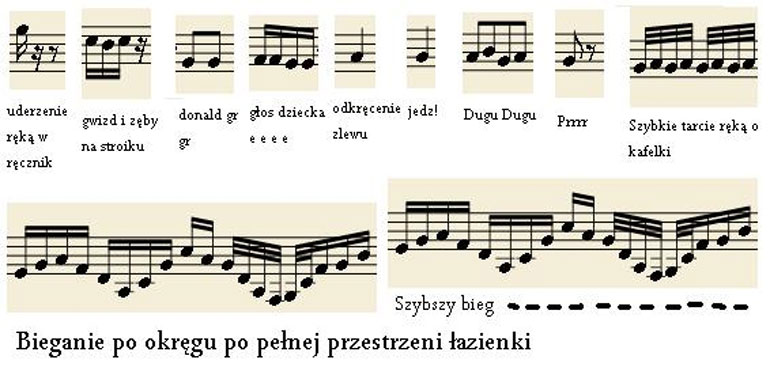
Ambit 3 is real gathering momentum from the place where the note stand is to the line of the audience. The illustrating word is 'running'.
Ambit 4 is a crazy run-around not restrained by space. The illustrating word is 'herd of horses'.
The linking of the activities of the instrumentalist, the musician and the performer moving objects, that are used by me, only make sense when referring to notation. The improvised fragments are always based on structures proposed by me. My attachment to the issue of notation is that important because what I seek in my method of natural multimediality is the furthest from theatrical or choreographic sense of its message. Movement and the use of voice is always treated as an attempt to build a homogenous line with the instrument, which plays or stops playing in the same moment that the above mentioned elements are in use. The relation issue seen from this perspective has more to do with directed composition than the known conceiving movement sequences. Here we have an example of a conscious use of something that could seem theatrical or choreographic but in relation submerged in structure. What I present I consider the basic gesture that has a real reference in the notation. I 'filter' the theatrical and the choreographic together with focusing on instrumental issues through elements characteristic for musical notation. Face grim + accent, face grim + dash, face grim + 8 sixteenths notes, I cut with clarinet phrases and my voice.
The area that I'm writing about, no matter how absurd and nonsense it might seem, is justified by the real behavior of instrumentalists – soloists like Sharon Kam on the clarinet. This is my note about the movements of ms. Kam and their meaning for performing phrases in a A major concert by W.A. Mozart.
Making a circle in the air with the head right in the beginning of the phrase and its end with more lively rhythmic values more lively head movements to the sides.
Head movement to the sides that accompanies the long note and getting in the zone, decreasing of the phrase and head movements again.
Pressing moves and accentuating together with musical equivalents.
Calm, wide, active movement.
And now for a change, how does this world of movement relate to all kinds of movements of Angus Young – the AC/DC guitarist.
Knee movement to the rhythm, walking that conveys the rock'n'roll spirit, head tilts back and forth.
Nodding with the head up and down, alternate stomping of the leg and the knee, first left than right, satisfied face.
Tilting the head while moving, in a straighten up position and than hunched, walking within a range of 5 meters.
I am certain that the body inspires the instrument to create a certain sound. Making various body installations to block the fingers, tighten the diaphragm, simply disturbing the performance, should become, in the contemporary music approach, the methods to prepare the instrument in a certain way, something I like to call 'deformation for expression'. Deforming one's initial, basic playing position, prepared for reading the notation and focused on music, one is able to search (like in the case of 'different instrument preparation' through beatbox) new instrumental techniques within this idea. More so because we can note sequences of movements coming from different music styles and interpret it through the notion of 'contemporary music'. Here are some examples of those 'deformations' of the initial position and their sound effects.
Tic/cs – sharp head movement downwards – 4 sixteenths – e e e i i i – bbbbbbbbbbbbbbb r r r
HA! – loooooooow maaaaaaaaan n n n n – seee eeee ee veeeennn yearsssss agooooo
Bm bmmm BBBBBBBBBMMMMM!!! – rrrrrrrrrr lowest clarinet 'E'
Tur fur Ti tur e i - (E and quarter notes) - PPPP m PPPP mi PPPP didididi
EEEEEE eeeeeee EEEEEEE RRRR rrrrrrrrrrrr wwwwwww WWW!!!!!!!!!
When taking the initial position, we automatically assume 'deformation'. From then on we can forget gravity. Music denies gravity thanks to movement. Placing the sound, as it were, naturally in space outside the imperative of proper posture, allows to experiment with various distances. Distances towards the audience, highs in relation to the audience, speed in relation to the audience. All this leads to building sound constructions in space. Here is an example of a piece – an étude that uses this idea including inspiration with beatboxing techniques.
I play Tum – I jump 2 meters forward – Tum repeated while in air – Tum played immediately after landing with great exultation – repeated in the position „as if wanting to throw it” – Tum Tum Tum Tum Tum played in constant movement, stiff movements.
Beyond gravity we have to focus on the subject of natural multimediality as a process of sending impulses to the audience. In order to do that I surround myself with various elements that allow me to do so. I'm guided here by the rule of musicalizing any possible scenic message element. I's one of the main rules of 'composed education'.
Notation stand moved with one touch – repeating that movement with eights „like clockwork” to the tune of Tu Gu Tu Gu – Question: „Can one plaaaaaa a a a – clarinet d1 d1 d1 - a a a [CRESC. louder and louder], even more even, yes yes yes yes infinitely even”. I would have to be the structure of an atom to be ultra even. Sh C - broad movements quickly – hmhm – ATOM!!!
And finally, finishing this chapter of études I'd like to present the issue of movement as a permanent musical element. A notation illustrating different approaches to movement and play will help us.
And so we have:
We remove from the chords structure its individual ingredients and we put in gesture – in the course where movement, pronounced word will be described by music notation the chord will become more homogenous in respect to the other scenic action elements.
/ - = * A tic of an arm as a sixteenth with an accent played on the highest possible pitch < / „ { A tic of an arm played very low as a quarter note indicating expression „heavily” - ^%#>. Arm movement barely noticeable...
C ( these are tones) D clarinet sharp and suddenly to the right E with BRRR – clarinet slightly upwards + s s s s – F (speech: being on the level of tone F I play with absolute involvement) – G G G G – whole body without limits folding to the ground
Elbow makes the letter „s”, knee simultaneously „o”, head „i” + rhythmic high pitch sound of the clarinet TTTT g g TT s z s z. Perform this structure during 30 seconds.
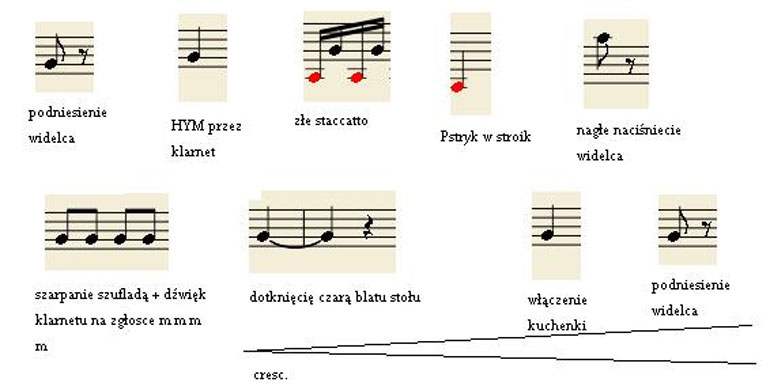
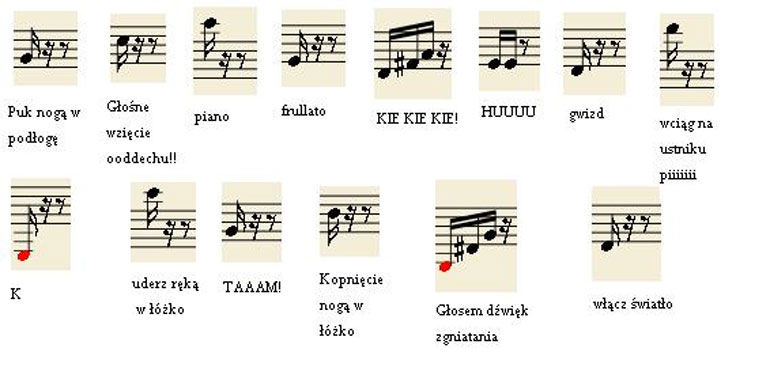
All that finally in my opinion depends on the type of space I'm in. So we have the following pieces:
The development of these „Études” was partially financed by an Artistic Scholarship granted to me by the Bureau of the City of Warsaw.