I have a list of my own 100 techniques which were created on the basis of my personal searches of different solutions for basic sounds and clarinet techniques. The initial assumption is an additional preparation of the occurred state that are the known techniques. Under those contemporary basis come, for example, multiphones, slaps, quarter notes, blowing air into the clarinet, playing an instrument and singing simultaneously. Within those basis we can build combinations multiphone + slap, multiphone + quarter tone, multiphone + blown air, multiphone + singing. What's used here is the addition method which I have described in the chapter about the notation of the études.
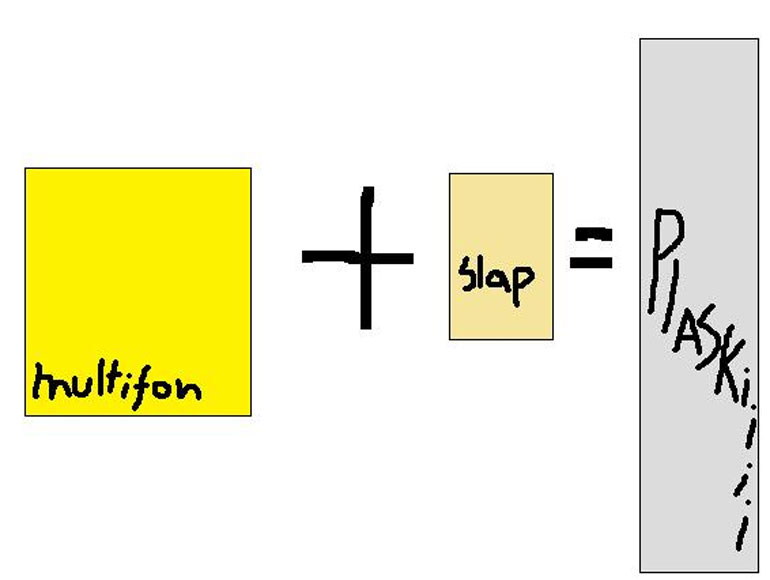
Killllka tkka dźwięków je- jed- jednocześnie dotknij stopa, udo i głowa dźwięków fffff oraz suchy slap PPPP T multi – slap – multi slap.
And nooooow! An original technique + the above mentioned examples. The initial question: 'Can you juxtapose slap + whistling + teeth on reed. Let's see:
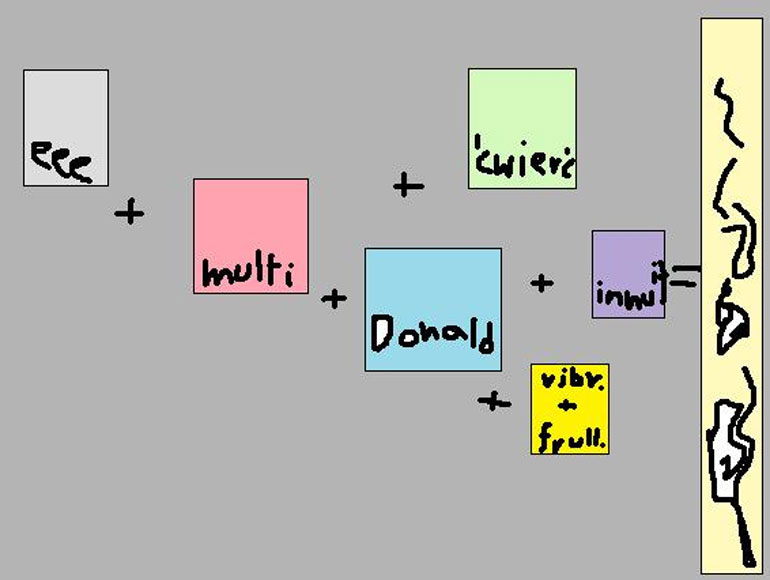
What we have here is an obvious interpretation of the slap concept by a vocalized brrr + spitting. Let's take a look at a couple of those collations and exercises that allow to enter the subject of 'lip mechanics'.
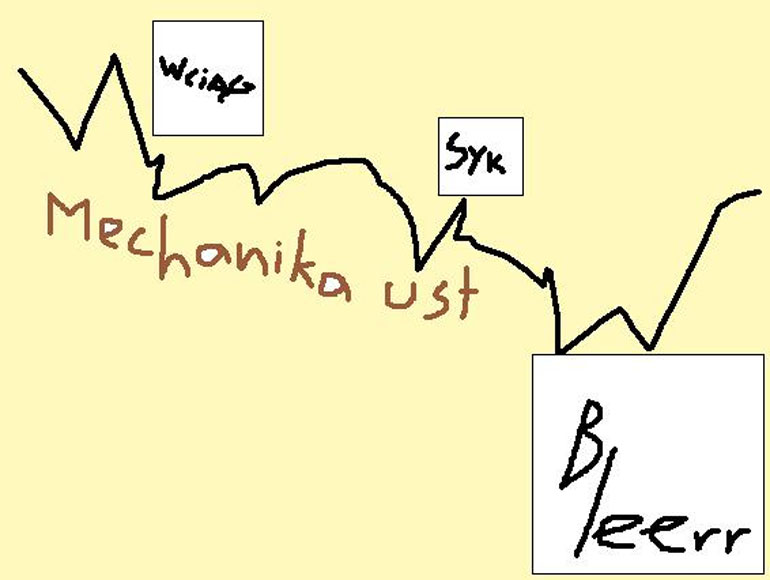
And nooooooow! Let us combine the concept of 'the mechanics of the lips' with 'the mechanics of fingers'. We are not focusing here on any given instrument sound, but on creating a specific finger movement, which, together with original techniques, should lead us to understanding the plastic structure of sound. Here's an example of programming finger movement:
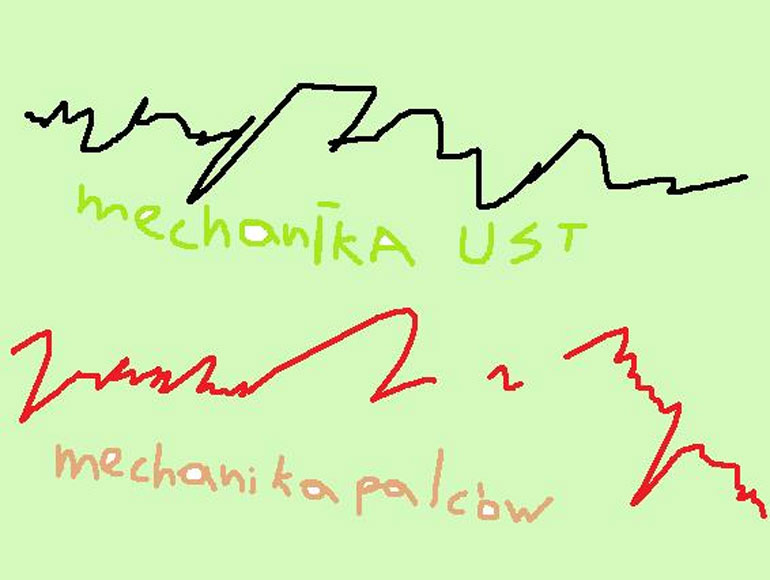
The kind of presenting the act of playing on the clarinet within the framework of a certain formation of shapes, that are a part of the instrument – music - space relation, allows a different kind of inspiring music. A sound, having it's source in a broadly understood motion, physics of movement and even further in the space of inspiration, that obviously in the imagination reveals signs of a real shifting on the scale of possibilities, becomes a phenomenon subjected to dynamic shape-shifting. It is even more possible because seeing clarinet technique as a certain point in the process of events, reacting to other mechanics such as mechanics of incidents and mechanics of space, allows to build the so called clarinet installations in a way that enters the space. Here are some examples of such mixing of the four dimensions: lip mechanics, the instrument, incidents and space.
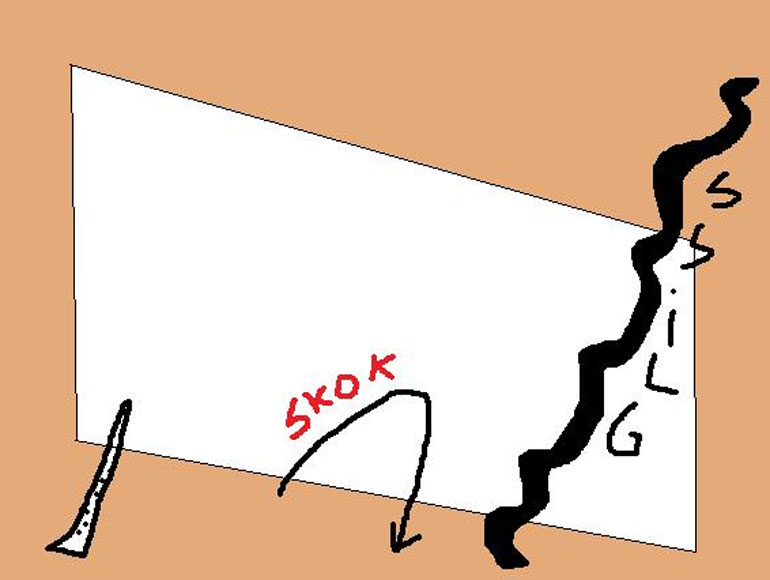
Using original techniques leads to broadening the concept of instrument preparation within the framework of the system suggested by the clarinet player. For me the more interesting subject is the question of sound deformation in order to broaden the spectrum of expression on the instrument. Obtaining various effects in that subject is about searching for scale of possibilities for given techniques, from which the values are brought out by juxtaposing sounds with the power of the word by means of experiment. Writing down the scale of possibilities gives us an idea of the extreme which we're dealing with and the word brings out the nuance and saturates the sound of the instrument. Exactly the extreme juxtaposition of conventions like:
![The expression of J. Brahms in great broadness + the barbarian howl of a wolf [glissando] played for 3 seconds](img/etiudy-klarnet37.jpg)
This advanced use of the instrument to make a sound, that directs the play to probably unexplored territory (the constant experimenting and searching of collations by placing numbers on the scale of possibility and on the list of techniques 1, 4, 7, 8, 31, 23) allows us to give in to the spirit of contemporary music and its genres involving constant pursuit. And so, a question arises, if by writing down music on a stave can one express the specificity of such a dynamic preparation based on constant synthesis of one technique with another? In my opinion no, giving the musician information about pitch, articulation, dynamics and rhythm is insufficient. What is needed are hints about movement and sound evolution based on reliable methods, that are the above mentioned elements of the notation but also on graphic solutions, words and photos. Here are the possibilities of my original techniques juxtaposed with graphics, additional word and photos.
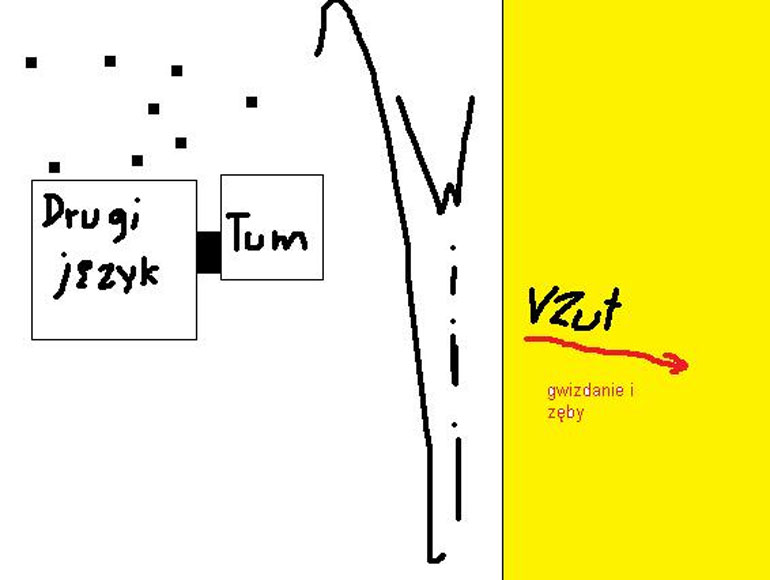
This approach to writing down various sound incidents inevitably leads music to the term 'freak standard'. Oddities should be systematized so that they can form a real dialogue with the musical tradition. Only this way can the experiment have a chance to bring out the value hidden under the layer of unpleasant pitches.
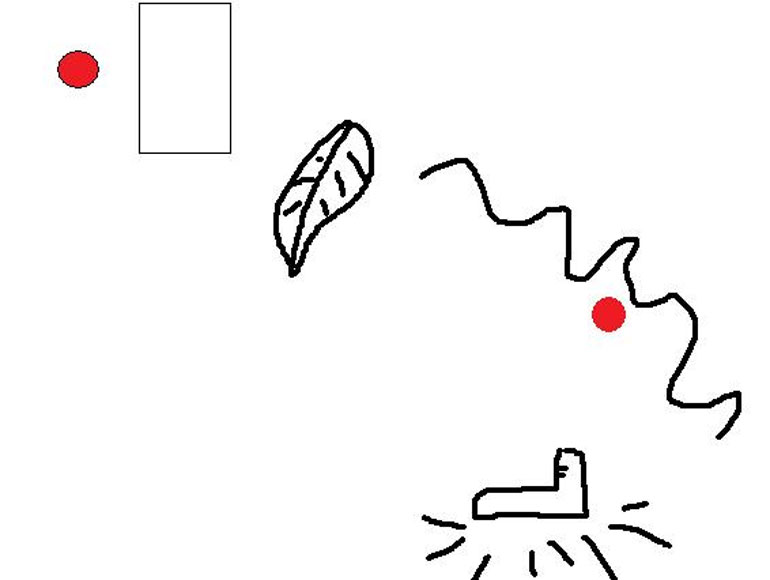
Let's now try to arrange my original techniques and bring out the rhythmic structures inspired with beatbox out of the suggested sequences. Here is the list of those techniques from 1 to 100. We are now going to build exercises that try to bring different techniques into one entity. This will be, without a doubt, an exercise of sound oddity.
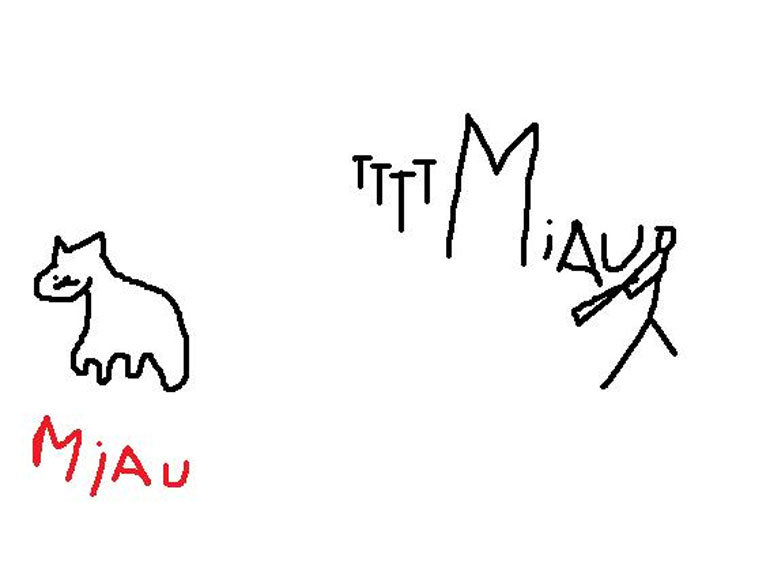
Because the above enlisted techniques are, in their character, similar to natural sounds occurring in space, I'd like to try to blend into the surroundings by causing different kinds of co – sounds. For example rubbing can be imitated and expanded within a certain dialogue between the instrument and the object.
Original techniques in a special way can be inspired to exist if they are performed by the audience playing an active part in the concert. For example a request for a high pitch whistle can have its place in the spacial score prepared especially for the concert. I play three sounds + calm ultra high pitch whistle with the audience + sudden sound. Any concert participant who feels and sees their own input in the making of a musical piece contributes to broadening the definition of sacrum of the stage. Someone who is not an expert, not a musician, a biologist or a physician or a sportsman, having to do with sounds similar to space, has a possibility for a musical interaction. It's not possible in the so called classical music where virtuosity, the elitist message, the dignity and the gravity of the piece cause a sense of seriousness overload in the listener. They don't have the opportunity to enter the musical structure. It is kept back only for specialists. So we read music and art in a impressionist way, without the factor it use to have in the past that is the functional aspect that appears in the fellowship of a concert. A shaman banging on a drum made his audience believe in the possibility of interaction, in this case the interaction with the spirits. What I have in mind is a relation with the interpreted word on a level 'audience as ...' or 'I use ... to describe ...'. In such an approach the original techniques have a mission to 'speak' to the audience in a spacious way, that is, placed in space.
Moje techniki / My techniques
The development of these „Études” was partially financed by an Artistic Scholarship granted to me by the Bureau of the City of Warsaw.