'Tum – multiphone + high harmonic vibration – aaaaaaa... + an emphatic slap with elements of pitch'
Here is an example of structure. This way of building a 'phrase' and thinking about music has it's source in beatbox. Because, what does a world champion do in the field of emitting percussion sounds and other veeeeeery different by using his throat, lips, cheeks, teeth. He refines each sound so they sound like something real, something that can be refereed to as 'wow – super' and than he arranges these little hums, zooms, grumbles, ngys into a virtuosic structure, that would impress the greatest of contemporary music performers. Please try to achieve an articulation like Roxorloops in his most rapid snares. Hm. I'll try. Hold on, hold on. First you have to transport the beatboxing technique onto a particular sound within the possibilities of your instrument. Maybe the easiest in that aspect is the western concert flute because the mouth doesn't have a direct contact with the mouthpiece (only touching it not inserting). This situation makes the sound of the beatboxing technique on the flute come out right almost immediately. On the clarinet one has to tinker, regulate the mouthpiece and steer towards imitation and playing with phonetics rather than directly imitating the snare or hi-hat.
What is the definition of the so-called technique? It is what I have written, plus what I'm about to write. First of all gentlemen 'composers – preparers' of instruments (W. Szalonek, J. Cage, P. Billone, B. Ferneyhough) gave us, instrumentalists, a whole construction built on top of the foundations of the basic sound of an instrument, that can be heard in 'everyday melodies' (Clarinet Polka “Dziadek” [“A Grandpa”], W.A. Mozart's Clarinet Concerto in A major or the beginning of “Rhapsody in Blue” by G. Gershwin) 'Everyday melodies' in contemporary music become architecture, series, three sounds, chase for another pssssssss - shshshshshshuuuuuuu – thyyyyyyy effect, scattered over registers. Contemporary music interpreters are masters in reading the most utterly complicated and virtuosic space sounds (see Aaron Cassidys scores available on the internet, especially those for the solo instruments – an incredible notation, an incredible effect – I recommend!!!). Beatboxers are masters of articulating sounds. Watching Carl Rossman on the bass clarinet or Roxorloops – world beatbox vice-champion is a real pleasure, especially when you can tell yourself 'I'll never be able to do that'. So we have techniques that are part of contemporary music language. And we have beatboxing techniques, which, after being 'explored' further (by me on the clarinet for example) I hope will be used in contemporary pieces for playing and interpreting. To do that, one needs études, that is presentations of the possibilities of a certain sound like ts, hg, uit, or ng. A composer must have grounds to determine how to play, widening the current sets of techniques, and how one can change the original version he suggested.
'1. Tum – 2. multiphone + high harmonic vibration – 4.aaaaaa... + 5. An emphatic slap with elements of pitch'.
And now a riddle. Please spot the differences between the above structure and the one I've written in the beginning. Bravo! I've added numbers. What does that change? A lot. Beatboxing masters change the order of the techniques in such a twisted way that sometimes we have the impression of them singing the chorus and making the rhythm at the same time, like in Black Sabath's “Iron Man” in the solo performance of Rahzel. 'P – I – dP – Am – tsh – Iron man – dg – Teru reru re – Dhy – teru re'. My above written structure is a similar case. Combining 1, 2, 1, 3, 4, 3, 5, 5, 1, 1, 4, 2 and than adding a faster tempo (here starts the proper face muscle training) starts the proper performance of the structure. Referring to the statement that beatboxers consequently drift towards referring to their structures and sounds as 'wow – super', us from the ivory tower, versed in a different than the hip hop 'um – tsy – pum – tsy' music making, can use other term descriptions such as 'spectral wow – super', 'chromatic wow – super', or simply 'sonorist wow – super'. HOWEVER quoting myself and putting right here in this text the sentence I've just invented ' us from the ivory tower, versed in a different than the hip hop 'um – tsy – pum – tsy' music making, can use other term descriptions such as...' I claim what follows: such an approach means limiting the describing VOCABULARY widening the possibilities of the structure. Fear, outrage and spreading tension. These are the real angers that limit adding descriptions like 'extremely wild rotten multiphone' or 'rythmitize the multiphone with stinking, trip-hop scribbles to the concept of multiphone. The consequence of this makes impossible the connection between beatbox and contemporary music on the basis of a search for a common musical construction or the following poem:
'Among the ashes of jaws eeg and heeg
A versed virtuoso jumps like pig and digs like no one before.
Avant-garde! - thinks (to himself), and keeps sewing from notes the same juicy musical digressions
Haven't changed a lichen since the times of Mozart
Just filled up a bit like a bumble bee.'
I'm just on the right subject. The two first parts were a certain introduction to the concept of 'remix'. The same contemporary techniques taken from pieces written for a clarinet solo, placed next to beatboxing techniques determined musically as a structure described by specific naming and vocabulary, creates a situation that could be refereed to as 'remixing the contemporary clarinet literature'. Let us take W.Z. Zych's piece “Nieuspokojenie” [“Anxiety”] for a solo bass clarinet. It starts with a series of bisbigliands, that is a slight trilling using similar sounds (again the VOCABULARY). I start the subject of explaining what's the whole remixing about.
1. Slight trilling using similar sounds – 2. Ultra fast trilling using similar sounds – 3. bar number 2 – 4. eeeeeeeeee from top to bottom – 5. Vibration on shshshshsh – 6. tg yu tg yu, 7. emu uy eeeee tstststs'.
How could I define the beginning of the piece, how to name it and what will keep on guiding me on the path of remix and analysis of the following bars of W.Z. Zych's piece “Morze” [“The Sea”], yes, this rolling mass of water will lead me through it's 'generating descriptions' including the beach, conversations under water, sharks and a clear Hawaiian sky, of which I dream on this cold day. I cry all the more knowing that my spasm will become a part of the 'piece – story' in the part 'I miss Hawaii with the composers acquiescence”. The function of the original piece is, above all, a reason to scream, jump or a silent ecstasy in the name of all that, what can happen during performing and interpreting the piece.
Here is a list of my original techniques:
Whistling + teeth on the reed, Airplane, Donald Duck, Lip Trill + sound, Vowels + breathing, Spitting, Nervous, Sentimental, Tranquil, Mad, Delicate, Happy, Sad, Crying, Screaming, Crazy, Sexy, Hooligan, Old hag, Baby, Old fart, Decisive, Calmed, Tension, General, Homesick, Air inhalation, Talking instrument, Jazzy, Big tension, Quake, Frullato + vibrato, The movement of the mouthpiece in mouth, ending the sound with A!, Too high, too low, Azerbaijan, Shakuhachi, Ben Webster, Bad pizzicato, Bad staccato, Quick repetitions, Touching the palate, Power, Low repetitions, another tongue, Phlegm, Quick stucture, Eeeeeee voice, Tuva + frulatto, High voice + high pitch, The touch of the reed, Eating, High double staccato, Machine gun, Beatbox, Low and high sound, Cat, Cow, Dog, Chicken, Horse, Sheep, Monkey, Du – gu, du – gu, The Innu people (Eskimo), Pressing with mouth, Tsy + slap, Pressing with tongue, Phlegm while inhaling, another tongue, air sideways, Sharp sound blowing, Wedding ring, Clarinet with foot on the ground, Scratching the crank, Rubbing the clothes, Horizontal clarinet on the ground, High eeeeeeee voice, Smacking + slippers, The structures of the syllables, Breathing fast, Tapping the reed with the nail + tongue in reed, Africa, Jews, Poland, Japan, Monk, Coltrane, High pitched silent whistle, Rhythmic eeeeeee voice, Ua, ua, ua, ua, Pa, pa, pa and low pa, pa, pa, Blowing from a distance, Indians po wow, Film on fingers, Russian language, German language, French language, English language, Italian language, Japanese language etc. of languages in the course of time introducing them as sounds.
Contrasting this mass of inspirations with beatboxing techniques somehow creates the certainty that one will not have a chance to say 'stop, what now' but rather 'oh no, that's pointless'. Than, one has to think 'what is form?'.
Tum, A!, B, Ng, Ts, Psz, Hut, PS, Bm, Tuku tik, Uiki Uiki.
For John Cage, preparation of the instrument meant using objects to change the sound of the piano and for Witold Szalonek 'dismantling' or different kind of 'blowing in' underlined the changes in understanding the instrumental technique. In a similar way, 'preparation' of a wind instrument used with beatboxing means being inspired by a broadly understood phonetics. This matter is composed of the following inspirations: world languages, 'the great pretending' (great because it bases its own original sound on the real immensity of sounds one can meet in the universe), emotions and human types, ethnic techniques, proper beatboxing techniques, deformation. 'Preparing in this context means constructing with voice around the mouthpiece in search of something else than: a) the tube of the instrument and b) reed – an acoustic resonator. Broadening this way of thinking about preparation is already in contrast and in interpretation of a given phonetic – instrumental technique, with the stock of effects in remixed contemporary pieces. This 'meddling' with the finished formula of a piece stems from the necessity of the author of this text. The author – instrumentalist (who can 'prepare' himself better than a musician) feels a necessity so that the emotional reference to the composed piece would follow from its 'over active' performance rather than reading the command 'dolce'. Thinking about a musical piece as of a puzzle structure where you can name fragments, where the bars can be arranged not only right left but also up and down, justifies the use of beatbox and thanks to the mutual interpretation makes 'preparation' more advanced. Here a drawing of how it all aligns.
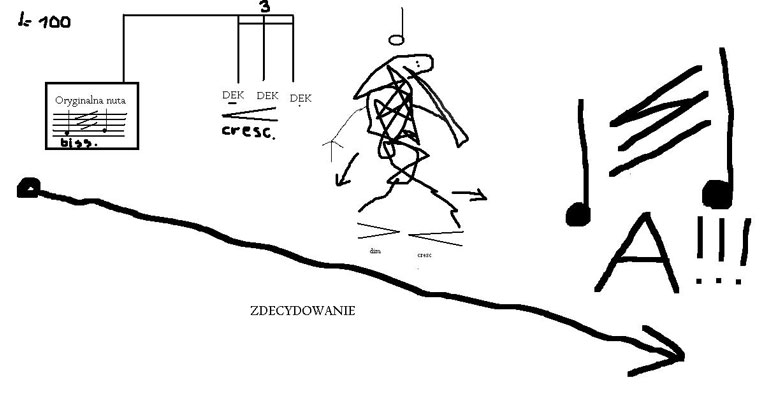
In order to specify how can this or that function in a piece or in an instrumentalist's technique of performance, a given, most abstract technique (meowing of a cat, thunder, roar of cars, from Lamborghini, through Polish Fiat 126p, to big trucks) I present my individual understanding of sense through specifying for example: 'High pitched meow, with an accent, played as a dotted quarter note, to fadeout' but it can also be expressed like this: 'meow G1 note in the middle of the piano, with a dash, squeezed second meow being a different eighth short extremely and with a multiphone taken from the remixed piece'. Creating this way10 versions of the use of 'meow' we make this silliness civilised for the use of composition and, what's more important we create a very important impression of 'controlling music matter'.
I do not want to 'fall into' hip-hop aesthetics but in controlling a certain self rhythmitizing and energizing state of 'musical matters' we detect a different space of inspiration following from body consciousness and a plastic deformation of the instruments sound. Building typically musical phrases between non musical elements such as: movement and performative action (within the notation they are to have a defined musical character) and musical effects (instrument and voice) we cause the widening of the concept of remix by adding the dimension of space in which we 'perform'. (measurements as a part of the score synonymous with the duration of the note). I called this phenomenon 'natural multimediality'. There is a tradition of a kind of performance where each part, the arms, the legs, the torso, the clarinet, each do their own thing (it's not absurd to talk about the rules of counterpoint between the parts of movement, voice, sound and action if they are used on stage as integral parts of the concert). It's mainly K. Stockhausen in the composition “Harlequin” and G. Aperghis in “Quatorze Jactations”. Movement here is an integral part of the music, intentional because it is written in the score. My experience, however, with these pieces brings me to the conclusion that the dramatization of the gesture leads to destroying the genuine relation between the movement and the instrument and it is, above all, about the real reaction of the sound to the body position. A simple, basic gesture introduces the assigned state. Using it as an integral part of remix of contemporary pieces provokes not only a dialogue between the given notes and the instrument but the whole musician – his or her physicality, awareness and space. It obviously has an influence on the controlled deformation of the sound of an instrument in any direction. From the notion of 'barbarity' (the musician acts like a mad bear with accents on the duration of one quarter note), through 'destruction' (sequences of movement 'spasms' drifting downwards or extreme, exaggerated finesse (tension in movement taken to ecstasy) to a planned stillness finish (stillness expressed in sixteenths).
Analysing the sense of including the original technique into the remixed fragment of a piece is connected with 'experimental contrasting'. Technique 1 + technique from the piece + technique 2 put together on the foundation of the beatboxing structure begin to interact in a different way. They become a dialogue between the ready piece and the proposed remix. The unpredictable becomes the advantage of the piece. Because it's impossible to predict what will a synthesis of 'slap' and 'Donald duck' sound like. One can verify it, though, by experimentally juxtaposing the techniques and than unbridled adding concepts like for example 'sleepy slap + Donald duck' or 'wild slap + slight Donald'. Unfortunately when such a juxtaposition is advanced it causes complications in decoding, which leads to a need of switching to linear thinking with whole processions of rhythms and sounds to understand music as interpreted by a multiplicity of inspirations and concepts of structure.
While using various elements including those non musical in a piece we face the problem of focusing and unfocusing in music. Focusing is indispensable to pass the musical form from beginning to end but in the case of 'natural multimediality', because of 'jumping' from instrument to voice and than movement and performance, we face the fact of unfocusing, for example, the instrument. The idea of the so called 'Overstructure' has been with me for 10 years now and I feel that my actions keep directing me towards this concept. 'Overstructure' is the consequence of using the notion of 'natural multimediality' in practice, it requires, however, a lot grater acceleration than I'm capable of right now. The ideal focusing and unfocusing can occur in a situation without gravity, in a real raise of elements and a total separation in space of the concept of remix (separation from gravity).
Blah and ugly sounds subjected to synthesis with the word 'musicalizing' become definite manifestations of other expressions. The statement 'ugly Bach' or 'howling Mozart' seem to be available but unspoken ideas. Juxtaposed 1 and 2 , interacting with intuition, imagining and feeling a wider plan of planned emotion (preparing a position for playing, deriving all sound from the attitude and position of the body) we create basis for musicalizing the destruction where, in the course of time in the piece, various elements become the building blocks of the concerts form.
Feeling, groove and yeah are notions characteristic for hip hop. Aow, boom and no! Are sounds taken from a dentist. Shshshshsh, splash and prrr are an obvious bathroom. When we perform a certain music style we fall into a vortex of rules. When the rule becomes a musical memo, from which we than build our own version of sound incidents, we make the 'directing' method into something more justified than the composition. That's because we can push our initial structure towards a given direction but we can't write down fragments that are a consequence of a musician's individual body tension. That's why describing the relation between the instrument and the body gives us the possibility to use 'feeling, groove and yeah'.
By building the form of the remixed pieces and also by playing the already developed notation we act within the principle of preparing grounds for improvisation being a consequence of the need to direct ( a musician is like a ball in a polyhedron box, he bounces off the successive walls led by the physics of movement). This kind of understanding of the improvisation is to be composer 'friendly' on the basis of a 50% - 50% input in the work. Only a creative musician can talk about the principles of functioning of their instrument and show the whole possible madness, that the composer will work on in the process of directing.
Playing 'difficult' things, equipped with 'extra melody', that is sound plus a hundred additions, should be, in my opinion, described with possibilities available to the musician. Announcing that the 'clarinet broke down' during a concert can be said 'cccccccclarinet brokeeeeeeee dooooown b – b – b – b – b – b – b – b – because O! I just played veeeeeeeeery fast things. 'Slap p p p p p oooooooo (sports arena roar) a fragment of the original piece and a shuffle of a foot'. - why was this odd? I will now maybe walk across the room and say it again: 'why was this odd?'. Causing the possibility of 'entering' of the audience into the structure of the played piece is, in my opinion, a needed and important challenge. The potential of contemporary music is huge but because of the 'extra melody' is somehow unavailable for the listener who is not ready aesthetically. Nothing by force. I promise. It's not about making the audience like what it doesn't want to. It's just about a basic truth that is creating, within the concert, a fellowship of human communication that's worthy of a Yakutian shaman.
The development of these „Études” was partially financed by an Artistic Scholarship granted to me by the Bureau of the City of Warsaw.